Purpose
-
Why was the Estabrook Woods created?
The idea of protecting Estabrook Woods as a nature preserve was first discussed by the Concord families that owned the Woods in the early 1950s; they considered protecting the woodlands as a "game preserve and sanctuary." One of the preliminary steps the owners took that began the protection of the woods was the legal closure of the Estabrook Trail to the public in 1932.
Through the 1950s, those families resisted offers by developers and began to consider how to protect the Woods. The Middlesex School, The Nature Conservancy, and Harvard University all were brought into the plan in the 1960s, which began with large transfers of land to the Nature Conservancy, and subsequently to Harvard. This effort brought the Concord citizens together who eventually formed the Concord Land Conservation Trust, which continues land preservation work to this day.
In 1969, the Commonwealth established a new law that enabled permanent conservation restrictions. Some landowners within Estabrook began to place their lands into permanent conservation restrictions. In 1971, the Town of Concord acquired the parcel now known as Punkatasset.
In the 1990s, the nature preserve was threatened by potential adjacent development. The Land Trust, the Trustees of Reservations, and other organizations worked together on “The Campaign for Estabrook Woods” to prevent adjacent development, which successfully added 400 acres of protected land to Estabrook Woods.
The result is an unusual situation where a large nature preserve is comprised of many parcels, held mainly by a group of private landowners, plus some lands belonging to the Towns of Concord and Carlisle. Most people are surprised to learn that the Town of Carlisle actually owns more of the woods (11%) than the Town of Concord owns (7%).
-
Is Estabrook Woods a nature preserve?
Most of Estabrook Woods is a private nature preserve. According to the Commonwealth of Massachusetts 2012 BioMap2 Study Estabrook Woods contains over 60% of Concord's space designated as Core Habitat, with 22 species listed as species of Conservation Concern.
The early creation of the Estabrook Woods began with large transfers of land to the Nature Conservancy, and subsequently to Harvard. Most of the property deeds to Harvard contain the following restriction clause:
“That said premises shall be maintained as a nature preserve for the purposes of field studies and research by the Museum of Comparative Zoology of Harvard University.”
Furthermore, much of Harvard's Property, and also the Town's land at Punkatasset, are subject to separate registered Nature Preserve Restrictions that require that the land be maintained as a nature preserve.
This means the property is legally bound to be a nature preserve. Harvard further clarified the public use of the Harvard land in their commitment to donors in 1966:
“Activities that might endanger the character of the Field Station as a natural preserve and activities that have not been permitted in recent years by the present owners will not be permitted by any visitor on any part of the Field Station.”
In addition, some landowners began to place their lands into permanent conservation restrictions under the newly created state law allowing those restrictions. This work contributed to the creation of the Concord Land Conservation Trust. In 1971, the Town acquired the parcel now known as Punkatasset. The Town's proposal for that acquisition stated:
"A major consideration in the importance of this acquisition is that this land forms a natural buffer along the southern and eastern boundaries of Harvard University's 650 acre Estabrook Woods "Biological Research Preserve."
In 1994, the Sierra Club stated that:
“The area known as Estabrook Woods in Concord and Carlisle may be the most important ecological reserve in our region of Massachusetts… we support the designation of Estabrook Woods as an Area of Critical Environmental Concern.”
In the 1990s the nature preserve was threatened by potential adjacent development. The Land Trust and other organizations worked together on “The Campaign for Estabrook Woods” to prevent adjacent development, which was largely successful.
From the early correspondence between the property owners, through today, the goal has been to create and maintain Estabrook Woods as a nature preserve. This is how the early landowners described it. It is how it was described in public announcements. It is legally mandated to be a nature preserve in many of the deed restrictions, and that is how the many current owners describe it and manage it. Estabrook Woods is mainly privately owned and the landowners intend to continue to work protect it as what it is: a nature preserve.
There are additional descriptions of the ecology and history of the Woods at The Estabrook Council website.
-
Is Estabrook Woods a public park?
No. A public park is publicly owned and managed for recreational use by the public. The Estabrook Woods is almost completely privately owned. In a nature preserve like Estabrook Woods, the land is managed for natural habitat, which requires that the nature of use and volume of use by the public be limited.
Most nature preserves do not allow vehicles, hunting, mountain bikes, or dogs; all of which threaten the peaceful existence of wildlife. There has been some promotion on the internet and social media of Estabrook Woods as a public park, or a destination for off-leash dog walking. This use is not considered compatible with management as a nature preserve (a survey found that no nature preserves allow off leash dogs, and over 60% do not allow dogs at all).
A frequently asked question at nature preserves is: "How can you have a park and not allow dogs?" A typical example response to this question is provided by a preserve in New York:
"As a nature preserve, these Woods are managed differently than a park is managed. Our goal is to maintain the biodiversity found in the nature preserve while allowing the public to visit this special area. There is scientific evidence that allowing dogs into nature preserves reduces the diversity of birds that will inhabit an area. Therefore, in keeping with our management plan, we do not allow dogs at this Nature Preserve."
There are people who would rather that Estabrook Woods be managed as a public park. Some lands do not have critical habitat, are too small, have no wildlife corridors, or have become sufficiently degraded that they are not suitable as nature preserves - and can be appropriately used as public parks. According to the Commonwealth, at this time, Estabrook remains a core habitat area for many endangered species, it is mainly privately owned, and the owners agree that it will remain a wildlife preserve and do not intend for it to become a public park.
-
What is the access to the Woods?
The Estabrook Woods Access Committee identified 21 entrances to Estabrook Woods. While most are private neighborhood entrances like Estabrook Road, eight have public access by right (because the access belongs to the Town, a land trust, or there is a deeded easement) or the owner has granted a license for public use. These public access points are Punkatasset, two at Monument Farm, Kibbe Place, Malcolm Preserve, Chamberlin Woods, Davis Corridor, and Prospect Street. The remaining thirteen accesses are private and are managed by the property owners; some of these provide no public parking and use is only by permission.
Some access points have parking available, these are:
Punkatasset: 8 spaces
Chamberlin Woods: 17 spaces
Estabrook Road: 7 spaces
Kibbe Place: 5 spaces
Malcolm Preserve: 9 spacesThe largest parking area serving the Estabrook Woods, the 17 car parking lot at the Chamberlin Woods entrance on Lowell Road, is at most times completely empty and essentially unused.
Ownership
-
Who owns the Estabrook Woods?
The 1700-acre Estabrook Woods is primarily private land, with the largest landowner being Harvard University which owns 682 acres (about 40% of the Woods). Private families own 28% of the Woods. The Town of Concord owns about 7% of the Woods and the Town of Carlisle owns about 11%. A summary chart showing the proprietors of the Woods is below:
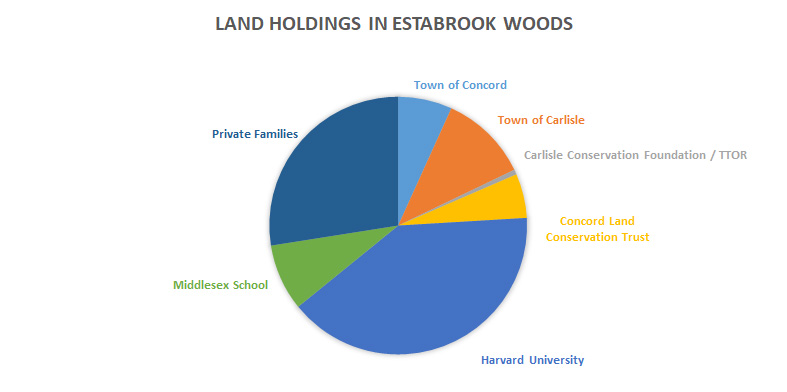
Many people are surprised to learn that the publicly owned land of Estabrook Woods makes up only 18% of the Woods and is primarily in Carlisle.
Some of the land in Estabrook Woods is subject to conservation restrictions. Despite some claims to the contrary, none of those restrictions were purchased with Concord taxpayer funds.
-
Who maintains the trails?
The property owners each maintain the trails on their respective land. The Town of Concord only maintains trails on the Town land at Punkatasset and Monument Farm. The Land Trust maintains trails on its land. The main Estabrook Trail is maintained by private property owners. There is no trails committee or other volunteer organization authorized to maintain trails in Estabrook Woods, except on some lands in Carlisle. Members of the public should not cut, clear, or otherwise maintain trails without the landowner's permission.
-
Who sets the rules?
There are many different parcels comprising the Estabrook Woods and each landowner could establish separate rules. To reduce confusion, many of the private landowners have agreed to a common set of rules, which are posted at various locations around the Woods. There are some landowners with different rules: The Towns of Concord and Carlisle each have their own rules; the Town of Concord has specific dog rules, and the Concord Land Conservation Trust has its own set of rules.
There is additional information about the rules for the Woods at The Estabrook Council website.
The Estabrook Trail
-
Who owns the Estabrook Trail?
The Estabrook Trail is privately owned. It passes across land of four private landowners and Harvard University. In some sections, different owners own opposite sides of the trail, with the boundary in the middle of the trail. The trail is 9340 ft long. 53% of the Trail, in the middle and northern sections, belongs to Harvard University (see map). Four other families hold the remaining 47% of the trail. The Trail is private land and there is no Town land on the Trail. The ownership of the trail is public information at the registry of deeds.
This is not disputed; the Select Board of the Town of Concord on Oct 1, 2018 issued a clarifying statement regarding this issue:
“The Town makes absolutely no claim of ownership of the Trail.”
The Concord Journal subsequently reported on Dec 4, 2018 that:
“Originally Town Manager Whelan had said he believed the trail was public land, but has since walked that claim back, having received confirmation from town counsel that the trail is on private land.”
-
What is the early history of Estabrook Trail?
The Estabrook Trail was created in parts over time. Historical documents show that the southern part of the Estabrook Trail was created by the landowners (not by the Town) as a private way around 1720.
In 1760, the County ordered that a private way be created from the Carlisle area to the south to connect to the existing private way near what is now Mink Pond, IF the landowners along the proposed road would agree to volunteer their land. However, there is no record that any of the landowners did give their land, so the creation of this section of the road was never officially confirmed.
There is little documented in the Town archives about the Trail, other that it was used for logging. It is not shown on any of the early Town maps of 1754, 1779, 1794, 1801, or 1819. What are now Monument Street and Lowell Road are on those maps and were the main roads to Carlisle and to the north. There is an old stone cellar hole along the Trail, said to have been the home of the Estabrooks, but archaeological studies of the site show that it dates to around 1790 when some local citizens obtained rights to mine lime on the same lot. What is known is that it was abandoned much earlier than 1830.
There is an apocryphal story that 19 minutemen from the north used the Trail to reach the North Bridge on April 19, 1775, but the original primary sources and recent research suggest they came down what is now known as Lowell Road.
The first record of the Estabrook Trail on a map is 1830, and shows no residential dwelling on it. In 1845, the author William Ellery Channing wrote a poem about a walk he took to the site of the abandoned cellar hole on the Trail; in that poem he said of the Trail: “No track had worn the old deserted road...no other signs of life beyond ourselves.” In 1859, Thoreau described it as a road "Undiscoverable to the uninitiated" and "…which no jockey, no wheelwright in his right mind drives over…”. In the Town records of 1891, Estabrook Trail is described as “little better than ruts through a piece of woodland.” In 1932, the Concord Road Commissioners said the Trail “has for a long period ceased to be in general public use” and voted to grant the landowner's request to close it to the public. These are just a few of the known quotes about the Trail.
There is additional information about the early history of Estabrook Woods at The Estabrook Council website.
-
What is the recent history of Estabrook Trail?
The Trail was discontinued in 1932 under a Mass General Law Chapter 82, Section 32A titled "Discontinuance of Certain Ways as Public Ways". The consequence of discontinuance is explained by the Massachusetts Executive Office of Environmental Affairs in their handbook titled Rights to the Sea: "Following a discontinuance, the publics easement of passage disappears and the land beneath the easement returns to the original landowner, free of easement." The documentation of this discontinuance are located here.
Following the discontinuance of 1932, the Trail was gated closed by the landowner (who owned both sides of the current Estabrook Road and both sides of the southern section of the Trail). What is now paved Estabrook Road served only the single homeowner, who owned the only two homes on Estabrook Road. The area around the current paved part of Estabrook Road was all open fields, and the Trail led into the woods. The Trail was used by friends and neighbors with permission. According to long-time neighbors, the Town and the owners were clear that the trail was private. The Town communicated this to landowners, to the public, and in various Town documents. The Town had told property owners deeper in the woods they could not develop their land because the trail was discontinued and could not be used for access. The trail was listed as "discontinued" in all public records.
The gate on the trail was first described in 1860 and is shown on maps of 1947 and 1956, and one of the first known photographs showing the gate was from 1968. The owners of the gate controlled access to the Trail, and used their section of the Trail as a maintenance road for their properties, which extended over one mile into the woods along the trail.
One of the only descriptions of rights to the Trail since 1932 is a letter written in 1995 by Mary P. Sherwood to Helen Bowdoin of the Thoreau Country Conservation Alliance, which says:
“The year being about 1958 or 1959…One day I decided I wanted to walk in along the Estabrook Trail… I knew an Emerson lived in the old house at the beginning of the trail and I felt I shouldn’t go in there without permission.”
Steadman Buttrick, the owner of much of Estabrook Woods in the 1960s, said in 1997 “People walk through Estabrook Woods now. They never used to.”
The property owners controlled access to the trail and installed and maintained a gate (1992 photo):
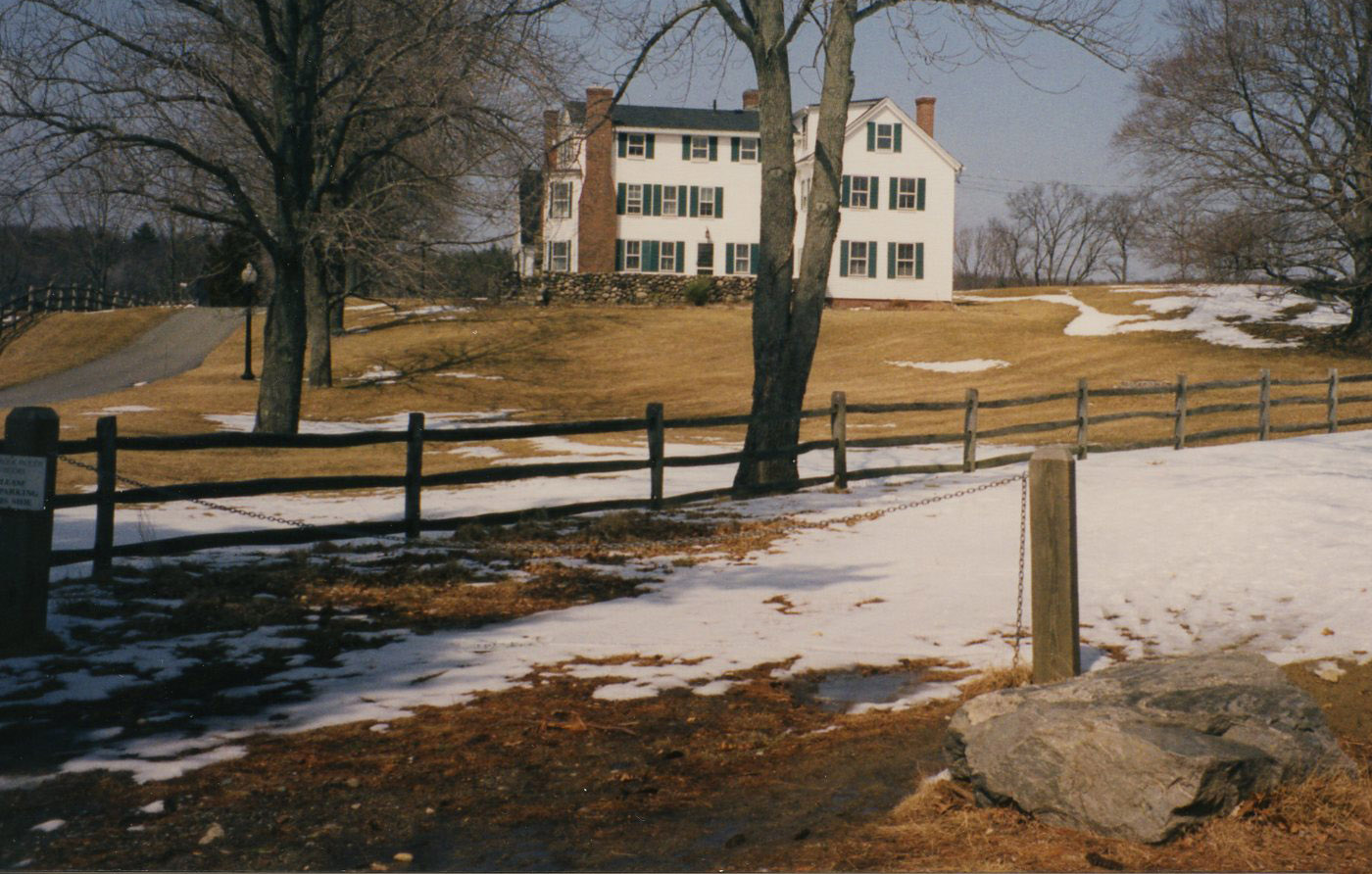
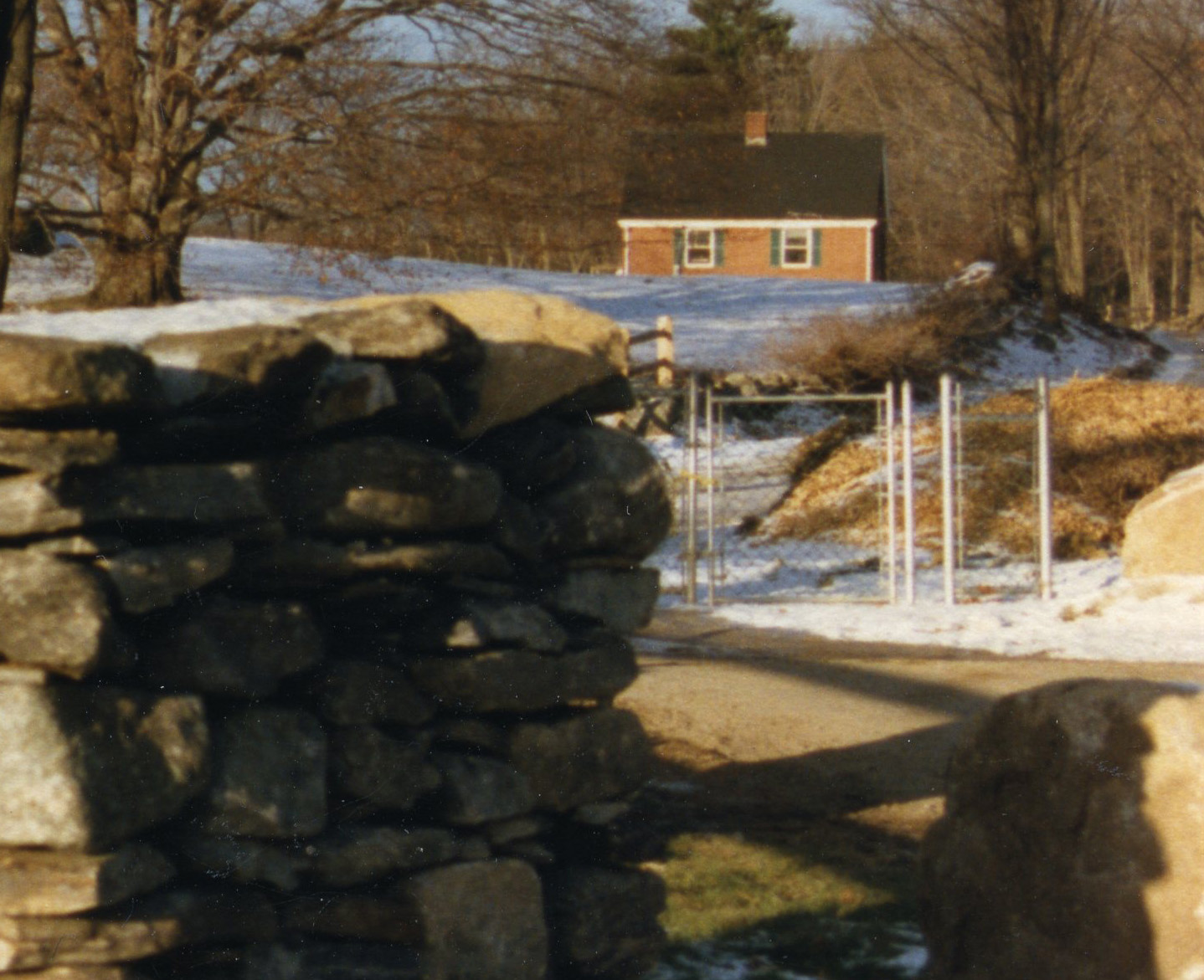
Note how difficult it is to see the chain in the photo, which is the key reason the chain gate was later replaced with a more visible white wooden gate. The landowners granted permission for the Trail's use, occasionally closing it for maintenance. For a time in the 1980s the trail was blocked with a chain-link fence:
During the 1990s, property owners made the southern Estabrook Trail entrance more inviting to the public by clearing and grooming the trails, taking down dozens of "No Trespassing" signs, creating scenic vistas, posting informational signage, and even constructing the current roadside parking area for visitors (which is still maintained by the property owners). A slow increase in the number of visitor began, which continued to increase over the following years, culminating in a very large growth of use around 2013-2016.
Around 2005, some Estabrook Woods landowners joined in posting harmonized rules for the woods:
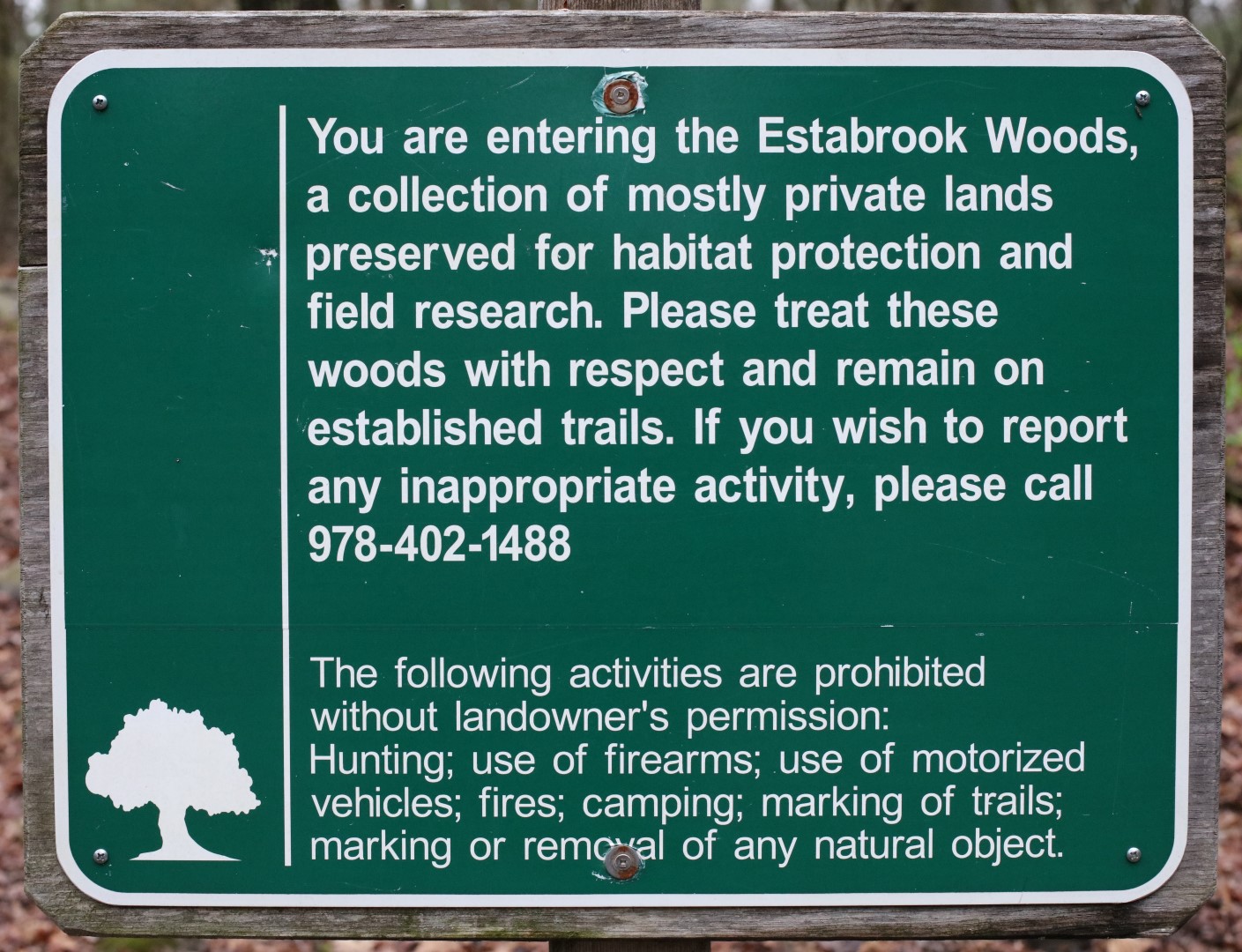
In the spring of 2016, these rules were updated based on feedback from the Town's Estabrook Woods Access Committee, and after seeking comment from the Town Manager:
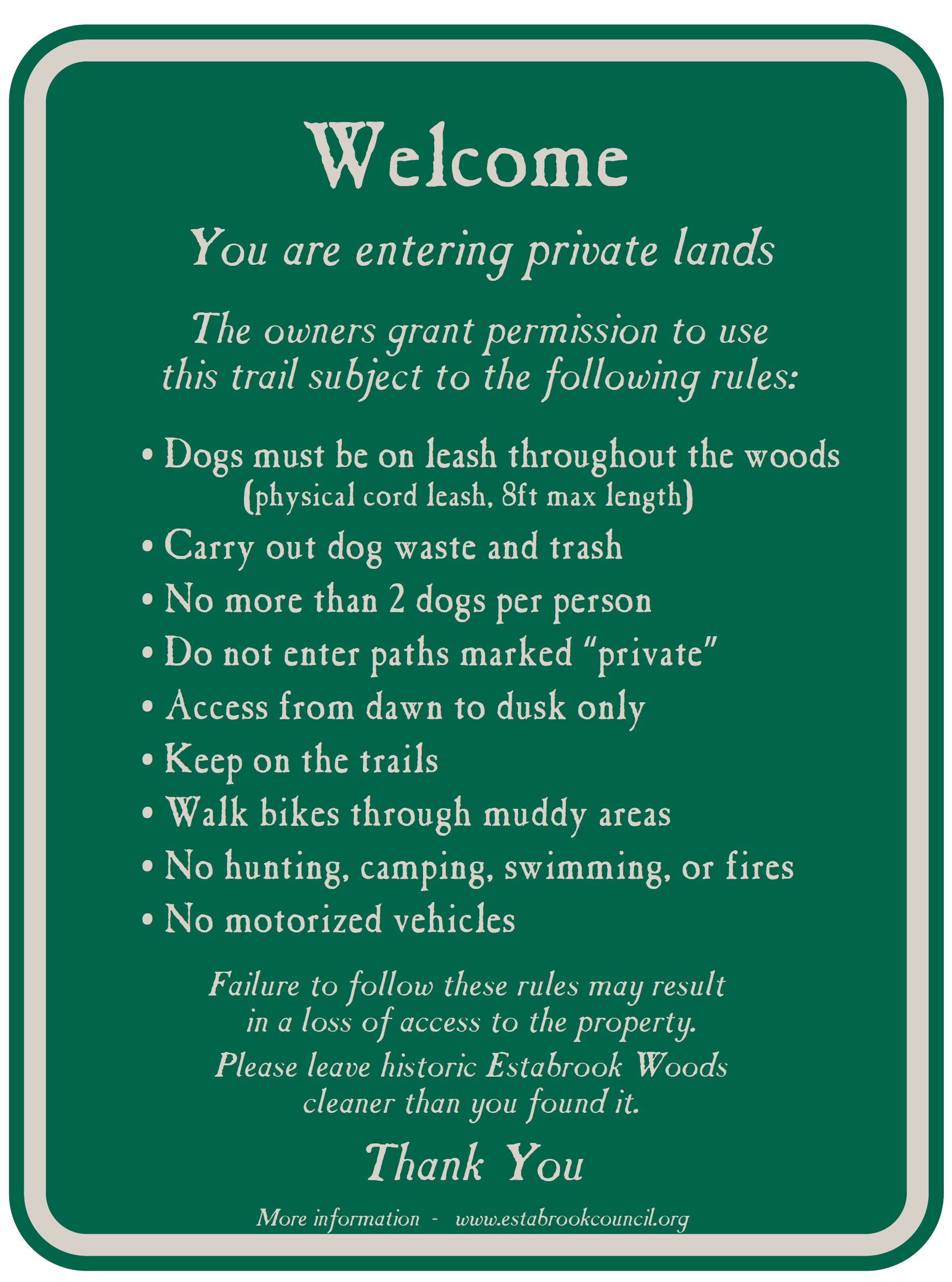
The volume of use began to increase dramatically starting around 2013, to the point where it overwhelmed the neighborhood by 2015. Over 18,000 dogs per year were passing through the residential property at the southern entrance of the Estabrook Trail alone, with increasing numbers at other access points as well. The type and volume of use was not consistent with a nature preserve or what the owners intended when they granted permission for visitors to use the Trail. The property owners approached the Town to request help in managing this problem. The Police determined that the situation was unsafe and implemented parking restrictions. These parking restrictions were objected to by visitors, which began a public controversy.
As late as June of 2016, the Town Manager reiterated the understanding that the Trail was private by saying at a public meeting that:
“The town abandoned the unpaved portion of Estabrook Road in 1932, and typically the public rights to use the road are abandoned at that time to the abutters. There is no publicly owned land in that general area. So there is no documented right of access.”
The Trail is a private way; the landowners have allowed public use, subject to certain conditions. The Town filed a lawsuit in October of 2017 seeking to change this and to seize access rights on the Trail owned by Harvard University and four resident landowners.
-
Is the Estabrook Trail a Public Way?
No. Courts have established that Estabrook Trail is a private way on private land. This is not disputed.
The official Town inventory of roads shows that Estabrook Road ends where the pavement ends, and there is no public way beyond this point.
Any uncertainty regarding this issue ended in 1932 when the owners asked if they could close the road and the road was formerly discontinued by the County. The discontinuance of 1932 specifically stated that the Trail was not a public way and was private. It is an undisputed fact that the Estabrook Trail is a private way. Furthermore, the Trail is ordered to be posted to "warn the public against entering."
The Controversy
-
What is the controversy about?
The conflict is fundamentally about whether the Estabrook Woods are to remain a nature preserve or become a public recreational park. The owners intend for it to remain a nature preserve.
A misunderstanding about the nature and ownership of the Woods unnecessarily escalated the controversy. The Town previously made some unfortunate representations such as characterizing the woods as part of "Concord's Open Space" and publishing some misleading maps. As a result, many citizens still mistakenly believe the Estabrook Woods to be public lands that they are entitled to use. In the newly updated Town Long Range Plan, the Planning Department recognized this problem, and has changed the descriptions of Estabrook Woods to more accurately reflect the private nature of most of the Estabrook Woods. Nevertheless, mis-perceptions remain.
Most of the land in Estabrook Woods, however, is private, and access is granted only by permission of the respective owners. Currently, that access is granted, as it has been through the recent past, under conditions meant to ensure that the Woods continue as a nature preserve and that the resident landowners, who have permitted the use of their lands, are not unduly impacted.
Around 1966, the Estabrook Woods was formed as a nature preserve as a result of the actions of a number of Concord families and Harvard University. The landowners since that time have permitted use of most of the woods by nature lovers. The Estabrook Trail goes across private residential and conservation land and is one of the many trails used by visitors. While the Woods were established to protect habitat from human impacts, people in increasing numbers are seeking recreational spaces for activities like dog walking and mountain biking that do impact habitat.
The Town, for decades, had been in unified agreement that the Woods should be protected for habitat value. In 1991, Concord's Open Space Plan expressed concern regarding managing increasing impacts:
"The Town should also continue to be alert to problems caused by recreational use of Estabrook Country... An effort should be made to control recreational use by not greatly expanding accessibility and parking."
Around 2015, the Woods came to be promoted as an off-leash dog park on the internet and elsewhere. The nature and volume of use changed dramatically. The small parking area at the Town’s public land began to overflow with dog walkers who began to use other private entrances to the Woods, especially the entrance to the Trail at Estabrook Road. The number of dogs brought into the Woods grew to over 20,000 per year. Numerous incidents between and among unleashed dogs with people, wildlife, and livestock followed. In addition, accumulations of dog feces were contaminating the trails and watershed areas. This use was not consistent with a nature preserve. Consequently, the landowners instituted a dog leash requirement and dog-waste pickup requirement in early 2016 to protect visitors and wildlife. At the end of 2017, the Town of Concord’s own Natural Resources Commission enacted the same rules on their part of the Estabrook Woods.
Off-leash dog advocates have objected to these leash requirements and are attempting to reverse or override them. They have attempted to bring articles to Town Meetings to force conservation lands to allow loose dogs. In the case of Estabrook Trail, they pressured the Town to try to seize control of the Trail to prevent landowners in Estabrook Woods from establishing rules for use of their own private lands.
As this situation was unfolding, Town officials were quoted in the newspaper making statements that were not accurate and thus served to inflame this situation, including:
“The public controls the access” (April 27, 2017)
“The Town’s view that the land is not private” (Oct 12, 2017)Unfortunately, it took over a year for the Town to issue corrections to their prior statements. In October of 2018 they clarified that:
“The Town makes absolutely no claim of ownership of the Trail.”
“The Town is in no way making any claim on the abutting private lands.”The Estabrook Woods Access Committee found that most people wrongly believe that the Estabrook Woods is public land which they are entitled to use. The Committee held public hearings where they explained that Estabrook Woods is mainly private, and also placed an op-ed in the Concord Journal explaining this. Nevertheless, the incorrect perceptions exist.
The Estabrook Woods landowners improved and groomed trails in the Woods, took down "no trespassing" signs, repaired stone walls, constructed and maintain a parking area for visitors, provide event parking for non-profit groups, and put up a "Welcome" sign. They are the only private landowners in Concord whose accommodations have been so extensive.
Other landowners who have permitted public use of their lands are watching this situation with great concern. The idea that allowing public use of your land could result in the public perceiving they have an unlimited entitlement, and the Town suing to seize control of your land, is naturally alarming.
-
What was the Estabrook Woods Access Committee?
In late 2015, the Police and the Town's Traffic Management Group responded to reports of parking problems on Estabrook Road and determined that parking controls were needed. These controls were put in place, limiting parking to the 11 road-shoulder parking spaces that had been created by a resident. When the Select Board considered ratification of these parking restrictions, concerns were raised about access limitations to Estabrook Woods. The subsequent discussions at the Select Board indicated confusion regarding what land was public, what trails were public, the purpose of the Woods, rules regarding use of the Woods, and what access was appropriate for Estabrook Woods. The Select Board established a committee to look into these and related issues and make recommendations to the Town.
The Committee was given a formal charge by the Select Board. While many people thought the purpose of the committee was to look at Estabrook Road parking, it is notable that the Committee charge considers the larger issue of Estabrook Woods and makes no reference to Estabrook Road.
The biggest problem the Committee faced was public misunderstanding regarding the ownership and purpose of the Woods. Even some Committee members were surprised to learn that Estabrook is mainly privately owned, and almost all public access is by permission. The Committee attempted to correct misunderstandings about the Woods in a Guest Commentary in the Concord Journal. Despite the efforts of the Committee to correct the mis-perception, much of the general public still does not understand that the land is private.
Another problem the Committee faced was the issue of protecting the Woods as a nature preserve, in light of the desire by some to use the Woods for utilitarian purposes - such as using it as a dog park or mountain bike riding course.
In addition, the Committee endeavored to quantify the level of impacts to the Woods and nearby residents, what was driving those impacts, and to what extent those impacts should be limited.
Finally, the Committee needed to identify and suggest what rules might be enacted to protect the Woods now and in the future.
The Committee struggled somewhat with its limited jurisdiction. Citizens were led to believe it could establish policy regarding the Woods, but, in reality, the Town only has authority related to the 7% of the Woods owned by the Town.
The Committee solicited input from the public and found that sentiments about Estabrook Woods fell into two opposing camps; either people were concerned about overuse and protecting the nature preserve, or they believed that Estabrook was a public park that people were entitled to use - and that access should be expanded. Many of the people concerned with overuse and impacts were particularly concerned about dogs, and problems with dogs. Those supporting access expansion believed access to "their public park" was being limited by nearby residents (some of whom were actually major landowners of the Woods). A central finding was that most people mistakenly believed that Estabrook Woods was public land, which often led to their beliefs about how it should be treated.
An example of a letter to the Town representative of those in favor of protecting the resource is here. An example of a letter in favor of providing expanded unfettered access is here. The difference in tone of these example letters was representative of the general tenor of the debate. What became clear to the Committee was that the mistaken belief that Estabrook Woods was public land was causing a lot of the hostility among members of the public, who often suggested there was a conspiracy to take away their rights. A review of various information about the Woods, such as Town maps, partially explained how some people may have come to believe the Estabrook Woods was public. The Committee tried to address this mis-perception during the public hearings, but it became clear that a much more sustained information campaign would be needed to correct mistaken beliefs held by many members of the public.
The Committee found that the demand drivers for use of the Estabrook Woods and its various access points were: desire for an off-leash dog park, promotion on social media and by word of mouth, availability of safe parking, quality of trails and scenic locations, and availability of Trail loop options.
Another core finding of the Committee was that almost all of the problems identified were related to dogs: dogs charging and frightening people, irresponsible dog owners, loose dogs bothering livestock, loose dogs invading residential property, dog feces, yellow snow at the access points, and dog-related noise. The Committee also found that Estabrook Woods was being promoted as a dog park. A group called "Metro-West Pack" was coming to the Woods and purposefully allowing their dogs to "socialize" and to hunt in packs in the Woods. Pet stores were recommending Estabrook Woods as a dog park destination. Concord's own visitor center was sending people who asked about dog parks to Estabrook Woods. Various books, on-line articles, and social media postings were promoting Estabrook Woods as a dog park. The Estabrook parking overload of 2015 was almost completely due to expansion of use as a dog park.
Another finding of the Committee was that there are 17 entrances to Estabrook Woods. Some of these entrances are clearly neighborhood entrances or private entrances with little or no parking, where the neighbors would object to expanded public access. The Committee was contacted by Carlisle representatives who requested that the Committee not make recommendations about or promote the entrances in Carlisle. But despite all of these entrances, many people knew of only two, which were Punkatasset and Estabrook Road - and they found that, of those two entrances, many felt Punkatasset was deficient due to unorganized and unsafe parking.
The Committee also found that the largest parking area for Estabrook Woods, a 17 car road-shoulder on Lowell Road at the Chamberlin Woods entrance, was underutilized and relatively unknown.
The Committee found uncertainty regarding the amount of parking along the Monument Street access at the Punkatasset. The Committee members found 13 parking spaces in use, but the Town Engineering department found that only 5-6 were actually considered safe parking spaces. While the Committee was working, a resident made driveway modifications that essentially eliminated 3 safe parking spaces.
The Committee had difficulty understanding the nature of the Estabrook Road access. The Town first advised the Committee that the Estabrook Road access was private; at the first Committee public hearing, the Town Manager said:
“The Town abandoned the unpaved portion of Estabrook Road in 1932, and typically the public rights to use the road are abandoned at that time to the abutters. There is no publicly owned land in that general area. So there is no documented right of access.”
About two-thirds of the way through the Committee's work, the Town reversed this position and said they believed the Town had some old public rights to the Trail, although the basis of these claims was not made public. The Estabrook property owners introduced a legal opinion that the access trail was private with no public rights, other than permission. The Committee expressed concern to the Select Board that this uncertainty made it difficult for them to make recommendations.
A key finding of the Committee was that the Town should focus on providing parking at Town-owned land, and not at private trail access points; that the majority of parking should be at the Town's land; and that parking should be safe, marked with appropriate signage, and well maintained.
The Committee needed to come to an agreement regarding the amount of parking spaces to recommend, and where to recommend they be located. The Committee decided to recommend to keep all existing parking, and to add some additional parking for Estabrook Woods, but that this additional parking be provided at the Town's lands at Punkatasset and Monument Farm Road. (It is notable that the parking capacity at the Town's lands has actually decreased in the two years after the Committee's recommendations).
Due to the uncertainties regarding public access rights on Estabrook Road, the Committee recommended that the Select Board work to resolve this issue. While this recommendation was being formed, the Committee was led to believe that the landowners and the Town were working on an agreement to allow public access, however the Town subsequently terminated these discussions on October 31, 2016. (see the section "Were there attempts to negotiate?" below)
The Committee suggested that common rules for Estabrook Woods be developed, with a particular focus on solving dog problems. The Committee suggested some rules but understood that it was actually up to the property owners to develop their respective rules.
The Select Board adopted the recommendations of the Committee, and made the following statement:
"The Committee concluded and the Board agree that, " ... that some visitors believe that the Woods are part of a large public park or a regional dog park, when in fact most of the land is privately owned for the purpose of research and conservation, with portions of trails generously open to the public. With few exceptions, these properties are managed by private landowners, without public funding or public staff. These misunderstandings are exacerbated by the internet, where information about the Woods (accurate and inaccurate) is now broadly available, attracting more users and sometimes conveying inaccuracies about the ownership, purpose, stewardship, and management of the Woods."
The complete Committee final recommendations are available here.
-
How are dogs involved in the controversy?
Most nature preserves exclude dogs, and the minority that do allow dogs almost universally require they be leashed. The owners of Estabrook Woods have always been committed to managing the Woods as a nature preserve, but had not established any rules about dogs before 2016 because the use of the Woods for dog walking was minimal.
However, around 2014 to 2016 Estabrook was promoted on the internet as a dog park, because it had no published rules regarding dogs. At the same time rules and enforcement regarding off-leash dogs were becoming increasingly strict in surrounding communities. The number of dogs brought to the Woods increased greatly. The dog counts passing through the Estabrook Road access alone went from around 2 per day to over 18,000 a year.
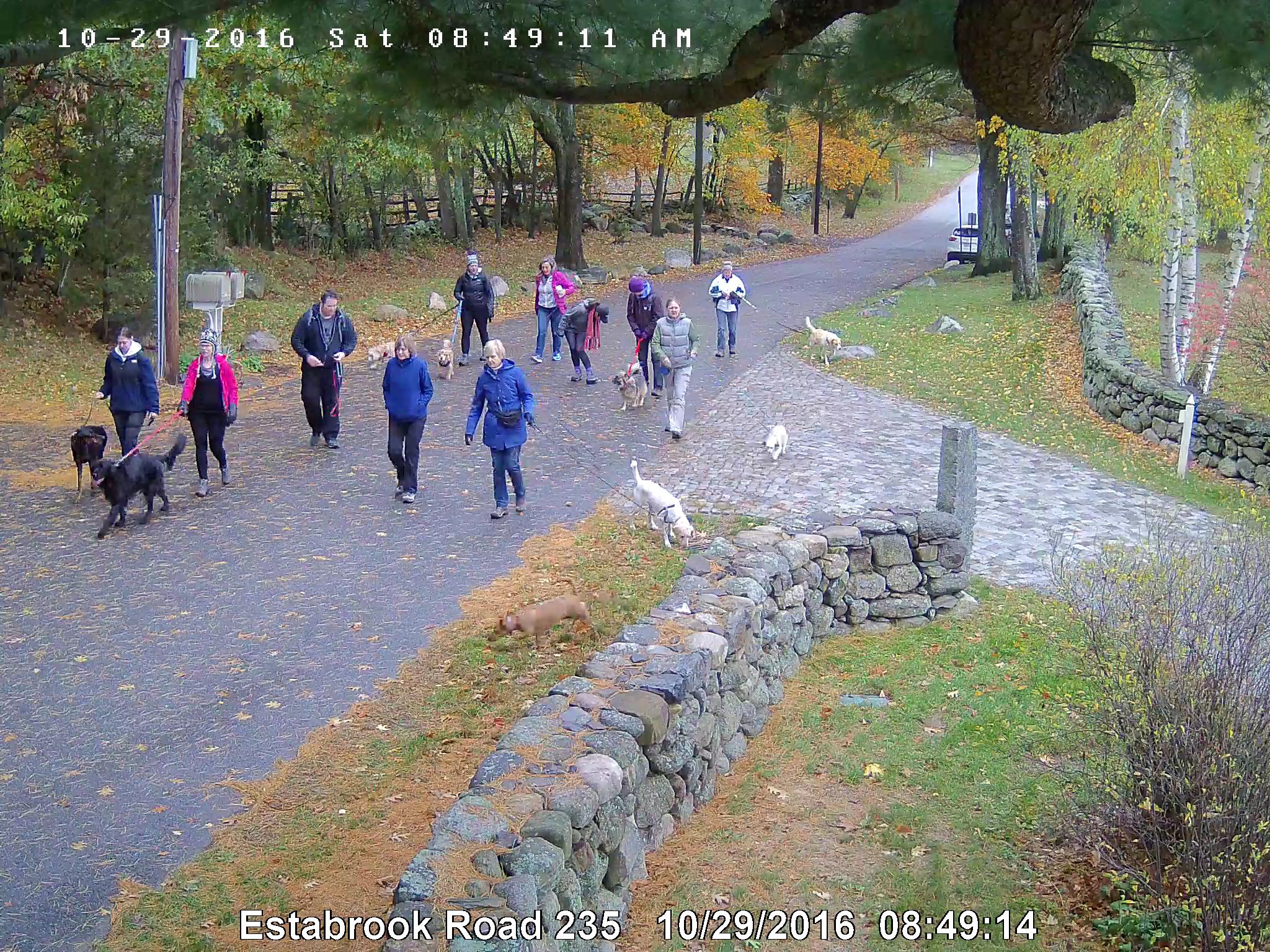
The owners of the Woods all agree that this level of use is incompatible with a nature preserve. Therefore, the private owners have adopted the rule that dogs must be on leash throughout most of Estabrook Woods. About a year later, the Town adopted the same rule on the Town land in another part of Estabrook, known as Punkatasset, which comprises about 7% of the Woods.
Certain dog walkers have objected to this rule. They have questioned the rights of private landowners to establish rules on private land. They first opposed, and then subsequently attempted to reverse the leash requirements on the Town land. They contend that Estabrook Woods is not a nature preserve. They have dismissed and denied the science showing how dogs impact wildlife. Some have said in public meeting that they do not- and will not- follow the posted rules. Unfortunately, extremists have leveled personal attacks against Estabrook Woods property owners and the Town's Natural Resources Commission.
According to the Department of the Interior, dogs are prohibited on many National Park trails because:
"-Dogs can carry disease into the park's wildlife populations.
-Dogs can chase and threaten wildlife, scaring birds and other animals away from nesting, feeding, and resting sites. Birds may abandon nests when they perceive threats or are disturbed. The scent left behind by a dog can signal the presence of a predator, disrupting or altering the behavior of park wildlife. Small animals may hide in their burrow the entire day after smelling a dog and may not venture out to feed.
-Dogs bark and disturb the quiet of the wilderness. Unfamiliar sights, sounds, and smells can disturb even the calmest, friendliest, and best-trained dog, causing them to behave unpredictably or bark excessively.
-Pets may become prey for larger predators such as coyotes and bears. In addition, if your dog disturbs and enrages a bear, it may lead the angry bear directly to you. Dogs can also encounter insects that bite and transmit disease and plants that are poisonous or full of painful thorns and burrs.
-Many people, especially children, are frightened by dogs, even small ones. Uncontrolled dogs can present a danger to other visitors."There are also direct confrontations with wildlife. In Estabrook Woods in one year there were at least 6 cases of dogs involved in fighting encounters with coyotes. Such coyote attacks normally occur when a coyote den is threatened.
Dog walkers contend that there is no data showing there are dog problems on conservation land in places like Concord. However, a study at Great Meadows National Wildlife Preserve did find a major impact when the decision was made to prohibit dogs at Great Meadows. The Trustees of Reservations recently announced it "has undergone a detailed, multi-year assessment, which has shown that increased visitation by people and dogs has generated considerable impact on certain habitats and overall visitor enjoyment." Furthermore, the Commonwealth of Massachusetts recently completed a multi-year study on this subject, in relation to State-owned conservation lands. The results of that study were presented to the public on Feb 6, 2018. The state study found that there were significant impacts of unleashed dogs on wildlife. The state study further found that unleashed dogs were responsible for significant safety problems related to visitors. In fact, they found that many people had negative encounters and were afraid to enter state conservation lands due to the threat of loose dogs, particularly people with children, people with medical conditions, and the elderly. The results of this study were sufficiently compelling such that the State, on March 14, 2018, instituted a new regulation that dogs must be leashed on all 220,000 acres of State conservation lands.
-
Has the controversy faded away?
The implementation of a leashing requirement, combined with coyote attacks on unleashed dogs, has caused the use by dog walkers to decline. The result is that usage of the woods had declined. The current parking capacity at the different sites is much larger than the current demand. For example, the 17 car capacity at Chamberlin Woods rarely has more than two cars, and often is empty.
The Estabrook Trail Lawsuit
-
How did the lawsuit start?
The landowners in 2015 asked the Town to help them because their property was being promoted as a regional dog park, and parking was causing unsafe road conditions. The Town departments responded with help to control the problems.
However, during that period, the Select Board and Town Manager were pressured by a group of citizens to create additional parking on the road; parking which would expand the use of the residential and private conservation land as a dog park. The landowners advised the Town that, while they had for decades permitted the use of their land by neighbors and nature lovers, that they would not allow their homes and their lands to become unsafe and overrun with inappropriate levels of use, or to become a regional dog park; and that they would need to restrict access on their land if parking was increased. Citizens who mistakenly believed the land to be public land exhorted Town officials to act. Town officials then began to threaten a lawsuit. The landowners offered the Town an agreement to allow public use as long as parking was not expanded. The Town originally was open to that agreement but abruptly broke off negotiations in October of 2016 and subsequently sued the landowners.
-
What was the lawsuit about?
The Town in October of 2017 filed a lawsuit against Harvard University and four property owners in the Estabrook Woods. The Town sought a declaration from the court that the Estabrook Trail at the end of Estabrook Road has unlimited public access which the owners cannot regulate. The Town admitted at a preliminary hearing on January 31, 2018 that the Trail is a private way on private land.
Incredibly, the Town never even spoke to the major landowner Harvard University before filing what would become a multi-million dollar lawsuit to take their property.
The lawsuit was not about access to the woods, or other trails in the woods, which are private. Only the rights to use the single trail through the woods were at issue.
The landowners position was that the Town does not have any record of the Trail as a public way, and furthermore it was discontinued as a way in 1932 by the county, and that the consequence of discontinuance is explained by the Massachusetts Executive Office of Environmental Affairs in their handbook titled Rights to the Sea: "Following a discontinuance, the publics easement of passage disappears and the land beneath the easement returns to the original landowner, free of easement." The landowners further noted that if the Town's interpretation of the old discontinuance law were to be accepted, then 85 owner's properties in Concord , and more than 1,000 around the Commonwealth, would suddenly have unrecorded public easements through them.
Much to the confusion of the defendants and their fellow citizens, the Town changed its story multiple times regarding what the lawsuit is about. These changes dramatically increased the cost of the lawsuit.
There was no precedent for a town to claim public rights on a discontinued way, and no court had ever issued an easement under such circumstances. The landowners own the Trail, and asked the court affirm their rights to their private land.
-
What happened with the lawsuit?
The Town initiate the lawsuit, without warning, in 2017. The residential property owners including Harvard filed a response to the lawsuit with counterclaims. Over 13,000 documents were produced in discovery. At a two-week trial evidence and testimony was introduced. The final written arguments were submitted in October of 2021.
The Land Court issued a ruling in favor of the town in 2022. The Court ruled in three parts: 1) that the road was a made public way and the records were lost; 2) that even if the road was not a public way, the use of the road by owners along it for logging and the use of 4 identified people including Henry Thoreau in the 1800s for walking made it a public way; and 3) that although the road was discontinued in 1932, that particular law establishes a public right of way on all roads so-discontinued.
The defendants filed an appeal in March 2024. The owners argument on appeal was that 1) Concord records are remarkably complete back to the 1600s and there is no legal basis to speculate that records were lost; 2) the use of the road by the owners along it, or the use for a few recreational walkers who never even record traversing the entire length of road, are not sufficient under the law to make a trail into a public way; 3) that the court erred when it created a novel interpretation of the early discontinuance law, Chapter 82 Section 32A, which ignored and will upend the status of thousands of properties around the Commonwealth, and 4) The Court's order that the owners remove the gate on the entrance to the road is in direct conflict with state law Chapter 86 Section 5, which specifically provides that owners on a private way may gate it closed. The appeals court did not address any of these arguments and simply affirmed the ruling of the land court.
The defendants then further appealed the case to the Supreme Judicial Court (SJC) in March of 2025. The SJC accepts fewer than 3% of cases. However, in this case the Real Estate Bar Association (REBA) petitioned the court to consider the case due to its precedent-setting nature. The defendants legal brief this time was supported by third-party Amici Briefs from REBA, the Massachusetts Association of Land Surveyors and Civil Engineers, a large group of Municipalities and Counties, and a number of private landowners with land on similarly discontinued ways, all of which urge the court to reverse the lower court decision. In a remarkable decision, the SJC did not respond to any of the briefs filed by the Amici, did not address the issue of how the lower court decision conflicted with the law, and did not consider any of the fact evidence that contradicted the lower court ruling. The SJC found that records of the way must have been lost. They found that the way is a private way, but of a unique new type that allows public travel. They upheld the lower court ruling that although the way is a private way the owners cannot prevent the public from traveling on it. They were silent on what rights the owners have on the way, rights that are established in the law and in other cases.
-
What is the practical result of the lawsuit ?
The first and most important result is that the Town unnecessarily spent over $2,000,000 on the lawsuit they initiated. The owners had offered the town an agreement to allow public use of Estabrook Trail, which would have had the same result and been free. The cost was more than 40 times what the Town's lawyers had represented that this case would cost.
The second result is that miles of popular trails formerly open to the public have been closed by the owners. This has caused a significant reduction in use of the Woods overall.
Another result is that as a result of the controversy the owners made the decision to disallow off-leash dog walking, on those properties were access is otherwise still permitted. This also caused a significant reduction in use of the Woods.
Another result is that private property owners in Concord and in surrounding Towns have closed trails due to the threat of lawsuit.
The lawsuit did not resolve many issues about the Trail, which continue. The ruling directly conflicts with multiple statutory laws, which take precedence over any court decision. For example, the court found the trail to be a private way. The law specifically allows owners to gate such private ways, yet the court ignored that law without explanation and ruled the gate, which the court found has been there since 1866, cannot be closed. The court made the conflicted ruling that the Trail must be posted to "Warn the Public Against Entering" but the owners cannot deter the public from entering.
-
Why did lawsuit cost so much?
The Town spent over $2,000,000 on this lawsuit.
Lawsuits regarding rights regarding ways on land are typically not expensive because such rights are documented in deed instruments. This lawsuit is unusual because no such documents were found. Instead the Town provided various reasons why the court should consider that the Estabrook Trail was a public way for which the records were lost. In creating this theory, the Town has changed the basis of the case nine times over the course of four years. Each change by the Town essentially restarted the case, requiring new evidence and new legal analysis.
The Town originally told the court it intended to move for quick summary judgment in spring of 2019. However, the Town was unable to find evidence to support their position, and repeatedly retracted claims and even retracted the key part of their expert testimony. The Town repeatedly changed the claimed basis for the case, greatly extending the case. Over 13,000 documents were produced. The Town hired an expensive expert who wrote a false report and retracted it a year later. The Town claimed it had over 30 witnesses that the way was currently being used without permission of the owners, a claim which the Town retracted after two years. The Town forced the defense to depose many Town witnesses and then claimed they were all irrelevant. The Town deposed many of the owners over a long period and then argued their testimony to be irrelevant. Landowners proposed a settlement to the Town which the Town agreed to but only with Harvard, and then the Town reneged on that settlement and caused the court to order Harvard back into the case. The Town then claimed that the way must have been a Town way but the records were lost. All of these changes by the Town greatly expanded the cost of the litigation for the taxpayers and for the defendants.
The cost of this lawsuit was much greater than the funds it would have taken to improve parking and trails at all of the Town's public lands including Punkatasset; in fact, the Town Manager reported that no funds for Punkatasset are now available. The Select Board has recently heard that, due to decreased use, no additional parking is needed for Estabrook Woods. There are many public access points into the Estabrook Woods, so it is confusing why the Town sought control of a private entrance.
Estabrook Woods Myths
-
Was Estabrook Trail once the main road to Carlisle?
No. The main road north from the North Bridge was called Groton Road (now Lowell Road), which was officially created in 1699. Monument Street was created in 1734, and these two roads have always been the main roads to Carlisle and to the north. In 1754, the section of Estabrook Road that is currently paved first shows on a map, but only went as far as the end of the current paved road. The official Concord map of roads from 1794 shows both Lowell Road and Monument Street but does not show Estabrook Road or the Trail. The Estabrook Trail first shows on a map in 1830, nearly 100 years after Lowell Road and Monument Street were established. Not long after that time, the Trail was described by Town documents only as a logging road. In 1845, just a few years after the first records of the Trail, Ellery Channing already described the Estabrook Trail as “the deserted road.” By 1859, Thoreau wrote that the Trail was “not accepted by the Town or the traveling world”, and was “undiscoverable to the uninitiated.” Consistent with these descriptions, Town officials noted in 1891 that the Trail was “little more than ruts though a piece of woodland.” By 1932, Town officials said of the Trail that it “has for a long period ceased to be in general public use.” These are certainly not descriptions of a main road.
The Town's own records clearly establish that Estabrook Trail was just an old logging path used by the landowners, rather than a main road to Carlisle.
-
Does the public have long-standing rights to the woods?
No. The public has had permission over the past few decades to use the woods. There are limited, documented public rights to certain parcels in Estabrook Woods, most prominently including the Town land at Punkatasset; but those parcels are the exception.
The largest landowner in the Woods is Harvard University. As part of Harvard's charitable obligation, they laid out their approach to public use of their land. They permit use by residents of the Town of Concord for limited light recreation, with the right to restrict use at any time.
It may be the case that people like Thoreau, Emerson, and Ellery Channing walked in the Woods in the mid 1800s; they likewise traversed many other private lands in Concord. Those recreational walks certainly do not transform private lands into public lands.
Until the current controversy, the only historic record of a citizen recording their understanding of rights on the Estabrook Trail was by Mary Sherwood, who wrote: “The year being about 1958 or 1959…One day I decided I wanted to walk in along the Estabrook Trail… I knew an Emerson lived in the old house at the beginning of the trail and I felt I shouldn’t go in there without permission.”
It is important to remember that a "right" regarding land is something that is documented by a deed or contract. Only a few conservation parcels have a deed prescribing public rights. The public has had long-standing permission to use sections of the Woods, but not a right. A right to use land must be provided by documentation of that right.
-
Has the Estabrook Trail been used by the public for centuries?
No. Some people have suggested that unlimited public access should be provided to the private land of Estabrook Woods because “it has been used by the general public for centuries.” That is not true and no basis in fact has been provided for these claims.
After two years of research, the Town and the Estabrook landowners have collected all known references to historic use of the Estabrook Trail. Reviewing these references, the following conclusions can be drawn regarding the history of visitation of the Woods and the Estabrook Trail:
From the founding of Concord until Harvard’s acquisition of much of the Estabrook Woods (when the public was granted permission to walk on Harvard's part of the Estabrook Woods), there are only two records of visits to the Woods by people from the general public who were not friends or neighbors of the landowners, one in 1897 and one in 1958. In the first case, Edwin Bacon describes walking in the Woods on parts of the Trail and across many parcels in the Woods (see map). It is notable that Mr. Bacon did not enter or leave the Woods via Estabrook Road but rather by Monument Street. In the second case, Ms. Mary Sherwood asks permission before using the Estabrook Road access to the Estabrook Trail:
“The year being about 1958 or 1959…One day I decided I wanted to walk in along the Estabrook Trail… I knew an Emerson lived in the old house at the beginning of the trail and I felt I shouldn’t go in there without permission.”
Taken together, the historical record does not support the recently invented claims by some of “continuous use of the Trail by the general public for centuries”. After years of research by the Town and the landowners, the record shows only sporadic use of the Trail, primarily by the owners, their friends, and neighbors, until just recently, when public use slowly began to increase following Harvard’s grant of permission to use their part of the woods around 1966.
-
Did the Minute Men from Carlisle come down the Estabrook Trail in 1775?
No. The primary source documents, from Drake’s 1897 History of Middlesex County, show that the Minute Men from Carlisle (believed to be around 19 in number), came from Carlisle Center to Hildreth's Corner- which is at the intersection of what are now called Lowell Road and Barrett's Mill Road. That path would have been down Lowell Rd. According to tradition, some men joined the contingent along the way as they marched; these men are known to have lived on Lowell Road, and not on Estabrook Road. If the Minute Men had come down Estabrook Trail, they would have already been within sight of the bridge and would have neeed to backtrack 2/3 mile out of their way to go to Hildreth's Corner.
The most complete analysis of the Carlisle Minute Men and their march was recently published in the Carlisle Mosquito.
Since the 1970s, Carlisle Minute Man reenactors do walk down the Estabrook Trail each year on April 19th, because it is a safe way for a group to walk from Carlisle; the Trail owners have encouraged this ceremonial use.